A PCIe erratum of mpc85xx may causes a core hang when a link of PCIe
goes down. when the link goes down, Non-posted transactions issued
via the ATMU requiring completion result in an instruction stall.
At the same time a machine-check exception is generated to the core
to allow further processing by the handler. We implements the handler
which skips the instruction caused the stall.

This patch depends on patch:
powerpc/85xx: Add platform_device declaration to fsl_pci.h

Signed-off-by: Zhao Chenhui <b35336@freescale.com>
Signed-off-by: Li Yang <leoli@freescale.com>
Signed-off-by: Liu Shuo <soniccat.liu@gmail.com>
Signed-off-by: Jia Hongtao <hongtao.jia@freescale.com>
Signed-off-by: Scott Wood <scottwood@freescale.com>
Opcode and xopcode are useful definitions not just for KVM. Move these
definitions to asm/ppc-opcode.h for public use.

Also add the opcodes for LHAUX and LWZUX.

Signed-off-by: Jia Hongtao <hongtao.jia@freescale.com>
Signed-off-by: Li Yang <leoli@freescale.com>
[scottwood@freesacle.com: update commit message and rebase]
Signed-off-by: Scott Wood <scottwood@freescale.com>
Convert CONFIG_HOTPLUG_PCI from tristate to bool.  This only affects
the hotplug core; several of the hotplug drivers can still be modules.

Signed-off-by: Bjorn Helgaas <bhelgaas@google.com>
Acked-by: Rafael J. Wysocki <rafael.j.wysocki@intel.com>
Acked-by: Yinghai Lu <yinghai@kernel.org>
Unlike the other general-purpose SPRs, SPRG3 can be read by usermode
code, and is used in recent kernels to store the CPU and NUMA node
numbers so that they can be read by VDSO functions.  Thus we need to
load the guest's SPRG3 value into the real SPRG3 register when entering
the guest, and restore the host's value when exiting the guest.  We don't
need to save the guest SPRG3 value when exiting the guest as usermode
code can't modify SPRG3.

Signed-off-by: Paul Mackerras <paulus@samba.org>
Signed-off-by: Alexander Graf <agraf@suse.de>
On some PAE architectures, the entire range of physical memory could reside
outside the 32-bit limit. These systems need the ability to specify the
initrd location using 64-bit numbers.
This patch globally modifies the early_init_dt_setup_initrd_arch() function to
use 64-bit numbers instead of the current unsigned long.
There has been quite a bit of debate about whether to use u64 or phys_addr_t.
It was concluded to stick to u64 to be consistent with rest of the device
tree code. As summarized by Geert, "The address to load the initrd is decided
by the bootloader/user and set at that point later in time. The dtb should not
be tied to the kernel you are booting"
More details on the discussion can be found here:
https://lkml.org/lkml/2013/6/20/690https://lkml.org/lkml/2012/9/13/544
Signed-off-by: Santosh Shilimkar <santosh.shilimkar@ti.com>
Acked-by: Rob Herring <rob.herring@calxeda.com>
Acked-by: Vineet Gupta <vgupta@synopsys.com>
Acked-by: Jean-Christophe PLAGNIOL-VILLARD <plagnioj@jcrosoft.com>
Signed-off-by: Grant Likely <grant.likely@linaro.org>
When the task moves around the system, the corresponding cpuhw
per cpu strcuture should be popullated with the BHRB filter
request value so that PMU could be configured appropriately with
that during the next call into power_pmu_enable().

Signed-off-by: Anshuman Khandual <khandual@linux.vnet.ibm.com>
Acked-by: Michael Neuling <mikey@neuling.org>
Signed-off-by: Benjamin Herrenschmidt <benh@kernel.crashing.org>
Completely ignore BHRB privilege state filter request as we are
already configuring that with privilege state filtering attribute
for the accompanying PMU event. This would help achieve cleaner
user space interaction for BHRB.

This patch fixes a situation like this

Before patch:-
------------
./perf record -j any -e branch-misses:k ls
Error:
The sys_perf_event_open() syscall returned with 95 (Operation not
supported) for event (branch-misses:k).
/bin/dmesg may provide additional information.
No CONFIG_PERF_EVENTS=y kernel support configured?

Here 'perf record' actually copies over ':k' filter request into BHRB
privilege state filter config and our previous check in kernel would
fail that.

After patch:-
-------------
./perf record -j any -e branch-misses:k ls
perf  perf.data  perf.data.old  test-mmap-ring
[ perf record: Woken up 1 times to write data ]
[ perf record: Captured and wrote 0.002 MB perf.data (~102 samples)]

Signed-off-by: Anshuman Khandual <khandual@linux.vnet.ibm.com>
Acked-by: Michael Neuling <mikey@neuling.org>
Signed-off-by: Benjamin Herrenschmidt <benh@kernel.crashing.org>
Mark pnv_pci_init_ioda2_phb() as __init.  It is called only from an
init function (pnv_pci_init()), and it calls an init function
(pnv_pci_init_ioda_phb()):

    pnv_pci_init                # init
      pnv_pci_init_ioda2_phb    # non-init
	pnv_pci_init_ioda_phb   # init

This should fix a section mismatch warning.

Signed-off-by: Bjorn Helgaas <bhelgaas@google.com>
Signed-off-by: Benjamin Herrenschmidt <benh@kernel.crashing.org>
The sllp value is stored in mmu_psize_defs in such a way that we can easily OR
the value to get the operand for slbmte instruction. ie, the L and LP bits are
not contiguous. Decode the bits and use them correctly in tlbie.
regression is introduced by 1f6aaaccb1
"powerpc: Update tlbie/tlbiel as per ISA doc"

Reported-by: Paul Mackerras <paulus@samba.org>
Signed-off-by: Aneesh Kumar K.V <aneesh.kumar@linux.vnet.ibm.com>
Signed-off-by: Benjamin Herrenschmidt <benh@kernel.crashing.org>
We should not fallthrough different case statements in hpte_decode. Add
break statement to break out of the switch. The regression is introduced by
dcda287a9b "powerpc/mm: Simplify hpte_decode"

Reported-by: Paul Mackerras <paulus@samba.org>
Signed-off-by: Aneesh Kumar K.V <aneesh.kumar@linux.vnet.ibm.com>
Signed-off-by: Benjamin Herrenschmidt <benh@kernel.crashing.org>
Commit 801eb73f45 introduced
a bug while checking PTE flags. We have to drop the _PAGE_COHERENT flag
when __PAGE_NO_CACHE is set and the cache update policy is not write-through
(i.e. _PAGE_WRITETHRU is not set)

Signed-off-by: Denis Kirjanov <kda@linux-powerpc.org>
Reviewed-by: Aneesh Kumar K.V <aneesh.kumar@linux.vnet.ibm.com>
CC:  Michael Ellerman <michael@ellerman.id.au>
Signed-off-by: Benjamin Herrenschmidt <benh@kernel.crashing.org>
The patch introduces flag EEH_DEV_SYSFS to keep track that the sysfs
entries for the corresponding EEH device (then PCI device) has been
added or removed, in order to avoid race condition.

Signed-off-by: Gavin Shan <shangw@linux.vnet.ibm.com>
Signed-off-by: Benjamin Herrenschmidt <benh@kernel.crashing.org>
While restoring BARs for one specific PCI device, the pci_dev
instance should have been released. So it's not reliable to use
the pci_dev instance on restoring BARs. However, we still need
some information (e.g. PCIe capability position, header type) from
the pci_dev instance. So we have to store those information to
EEH device in advance.

Signed-off-by: Gavin Shan <shangw@linux.vnet.ibm.com>
Signed-off-by: Benjamin Herrenschmidt <benh@kernel.crashing.org>
When EEH error happens to one specific PE, some devices with drivers
supporting EEH won't except hotplug on the device. However, there
might have other deivces without driver, or with driver without EEH
support. For the case, we need do partial hotplug in order to make
sure that the PE becomes absolutely quite during reset. Otherise,
the PE reset might fail and leads to failure of error recovery.

The current code doesn't handle that 'mixed' case properly, it either
uses the error callbacks to the drivers, or tries hotplug, but doesn't
handle a PE (EEH domain) composed of a combination of the two.

The patch intends to support so-called "partial" hotplug for EEH:
Before we do reset, we stop and remove those PCI devices without
EEH sensitive driver. The corresponding EEH devices are not detached
from its PE, but with special flag. After the reset is done, those
EEH devices with the special flag will be scanned one by one.

Signed-off-by: Gavin Shan <shangw@linux.vnet.ibm.com>
Signed-off-by: Benjamin Herrenschmidt <benh@kernel.crashing.org>
When EEH error happens to one specific PE, the device drivers
of its attached EEH devices (PCI devices) are checked to see
the further action: reset with complete hotplug, or reset without
hotplug. However, that's not enough for those PCI devices whose
drivers can't support EEH, or those PCI devices without driver.
So we need do so-called "partial hotplug" on basis of PCI devices.
In the situation, part of PCI devices of the specific PE are
unplugged and plugged again after PE reset.

The patch changes pcibios_add_pci_devices() so that it can support
full hotplug and so-called "partial" hotplug based on device-tree
or real hardware. It's notable that pci_of_scan.c has been changed
for a bit in order to support the "partial" hotplug based on dev-tree.

Most of the generic code already supports that, we just need to
plumb it properly on our side.

Signed-off-by: Gavin Shan <shangw@linux.vnet.ibm.com>
Signed-off-by: Benjamin Herrenschmidt <benh@kernel.crashing.org>
Currently, we're trasversing the EEH devices list using list_for_each_entry().
That's not safe enough because the EEH devices might be removed from
its parent PE while doing iteration. The patch replaces that with
list_for_each_entry_safe().

Signed-off-by: Gavin Shan <shangw@linux.vnet.ibm.com>
Signed-off-by: Benjamin Herrenschmidt <benh@kernel.crashing.org>
When we do normal hotplug, the PE (shadow EEH structure) shouldn't be
kept around.

However, we need to keep it if the hotplug an artifial one caused by
EEH errors recovery.

Since we remove EEH device through the PCI hook pcibios_release_device(),
the flag "purge_pe" passed to various functions is meaningless. So the patch
removes the meaningless flag and introduce new flag "EEH_PE_KEEP"
to save the PE while doing hotplug during EEH error recovery.

Signed-off-by: Gavin Shan <shangw@linux.vnet.ibm.com>
Signed-off-by: Benjamin Herrenschmidt <benh@kernel.crashing.org>
Make some functions public in order to support hotplug on either specific
PCI bus or PCI device in future.

Signed-off-by: Gavin Shan <shangw@linux.vnet.ibm.com>
Signed-off-by: Benjamin Herrenschmidt <benh@kernel.crashing.org>
We will rely on pcibios_release_device() to remove the EEH cache
and unbind EEH device for the specific PCI device. So we shouldn't
hold the reference to the PCI device from EEH cache and EEH device.
Otherwise, pcibios_release_device() won't be called as we expected.
The patch removes the reference to the PCI device in EEH core.

Signed-off-by: Gavin Shan <shangw@linux.vnet.ibm.com>
Signed-off-by: Benjamin Herrenschmidt <benh@kernel.crashing.org>
During Machine Check interrupt on pseries platform, R3 generally points to
memory region inside RTAS (FWNMI) area. We see r3 corruption because when RTAS
delivers the machine check exception it passes the address inside FWNMI area
with the top most bit set. This patch fixes this issue by masking top two bit
in machine check exception handler.

Signed-off-by: Mahesh Salgaonkar <mahesh@linux.vnet.ibm.com>
Signed-off-by: Benjamin Herrenschmidt <benh@kernel.crashing.org>
The presence or absence of EBB is advertised to userspace via the presence
or absence of PPC_FEATURE2_EBB in cpu_user_features2.

Because the kernel can be built without PMU support, we should only add
PPC_FEATURE2_EBB to cpu_user_features2 when we successfully register the
power8 PMU support.

Signed-off-by: Michael Ellerman <michael@ellerman.id.au>
Signed-off-by: Benjamin Herrenschmidt <benh@kernel.crashing.org>
The Kconfig symbol HOTPLUG was removed with commit 40b313608a ("Finally
eradicate CONFIG_HOTPLUG"). But there's still one select statement for
that symbol. It seems that select statement was added after the patch to
remove CONFIG_HOTPLUG was submitted. Anyhow, it is useless and can be
dropped.

Signed-off-by: Paul Bolle <pebolle@tiscali.nl>
Reviewed-by: Srivatsa S. Bhat <srivatsa.bhat@linux.vnet.ibm.com>
Signed-off-by: Benjamin Herrenschmidt <benh@kernel.crashing.org>
In hard_irq_disable(), we accessed the PACA before we hard disabled
the interrupts, potentially causing a warning as get_paca() will
us debug_smp_processor_id().

Move that to after the disabling, and also use local_paca directly
rather than get_paca() to avoid several redundant and useless checks.

Signed-off-by: Tiejun Chen <tiejun.chen@windriver.com>
Signed-off-by: Benjamin Herrenschmidt <benh@kernel.crashing.org>
Module CRCs are implemented as absolute symbols that get resolved by
a linker script. We build an intermediate .o that contains an
unresolved symbol for each CRC. genksysms parses this .o, calculates
the CRCs and writes a linker script that "resolves" the symbols to
the calculated CRC.

Unfortunately the ppc64 relocatable kernel sees these CRCs as symbols
that need relocating and relocates them at boot. Commit d4703aef
(module: handle ppc64 relocating kcrctabs when CONFIG_RELOCATABLE=y)
added a hook to reverse the bogus relocations. Part of this patch
created a symbol at 0x0:

# head -2 /proc/kallsyms
0000000000000000 T reloc_start
c000000000000000 T .__start

This reloc_start symbol is causing lots of confusion to perf. It
thinks reloc_start is a massive function that stretches from 0x0 to
0xc000000000000000 and we get various cryptic errors out of perf,
including:

problem incrementing symbol count, skipping event

This patch removes the  reloc_start linker script label and instead
defines it as PHYSICAL_START. We also need to wrap it with
CONFIG_PPC64 because the ppc32 kernel can set a non zero
PHYSICAL_START at compile time and we wouldn't want to subtract
it from the CRCs in that case.

Signed-off-by: Anton Blanchard <anton@samba.org>
Cc: <stable@kernel.org>
Acked-by: Rusty Russell <rusty@rustcorp.com.au>
Signed-off-by: Benjamin Herrenschmidt <benh@kernel.crashing.org>
POWER8 comes with two different PVRs.  This patch enables the additional
PVR in the cputable.

The existing entry (PVR=0x4b) is renamed to POWER8E and the new entry
(PVR=0x4d) is given POWER8.

Signed-off-by: Michael Neuling <mikey@neuling.org>
Signed-off-by: Benjamin Herrenschmidt <benh@kernel.crashing.org>
Pull perf/core improvements and fixes from Arnaldo Carvalho de Melo:

 * Add missing 'finished_round' event forwarding in 'perf inject', from Adrian Hunter.

 * Assorted tidy ups, from Adrian Hunter.

 * Fall back to sysfs event names when parsing fails, from Andi Kleen.

 * List pmu events in perf list, from Andi Kleen.

 * Cleanup some memory allocation/freeing uses, from David Ahern.

 * Add option to collapse undesired parts of call graph, from Greg Price.

 * Prep work for multi perf data file storage, from Jiri Olsa.

 * Add support for more than two files comparision in 'perf diff', from Jiri Olsa

 * A few more 'perf test' improvements, from Jiri Olsa

 * libtraceevent cleanups, from Namhyung Kim.

 * Remove odd build stall in 'perf sched' by moving a large struct initialization
   from a local variable to a global one, from Namhyung Kim.

 * Add support for callchains in the gtk UI, from Namhyung Kim.

 * Do not apply symfs for an absolute vmlinux path, fix from Namhyung Kim.

 * Use default include path notation for libtraceevent, from Robert Richter.

 * Fix 'make tools/perf', from Robert Richter.

 * Make Power7 events available, from Runzhen Wang.

 * Add --objdump option to 'perf top', from Sukadev Bhattiprolu.

Signed-off-by: Arnaldo Carvalho de Melo <acme@redhat.com>
Signed-off-by: Ingo Molnar <mingo@kernel.org>
This is called right after the memslots is updated, i.e. when the result
of update_memslots() gets installed in install_new_memslots().  Since
the memslots needs to be updated twice when we delete or move a memslot,
kvm_arch_commit_memory_region() does not correspond to this exactly.

In the following patch, x86 will use this new API to check if the mmio
generation has reached its maximum value, in which case mmio sptes need
to be flushed out.

Signed-off-by: Takuya Yoshikawa <yoshikawa_takuya_b1@lab.ntt.co.jp>
Acked-by: Alexander Graf <agraf@suse.de>
Reviewed-by: Xiao Guangrong <xiaoguangrong@linux.vnet.ibm.com>
Signed-off-by: Paolo Bonzini <pbonzini@redhat.com>
Pull networking fixes from David Miller:
 "Just a bunch of small fixes and tidy ups:

   1) Finish the "busy_poll" renames, from Eliezer Tamir.

   2) Fix RCU stalls in IFB driver, from Ding Tianhong.

   3) Linearize buffers properly in tun/macvtap zerocopy code.

   4) Don't crash on rmmod in vxlan, from Pravin B Shelar.

   5) Spinlock used before init in alx driver, from Maarten Lankhorst.

   6) A sparse warning fix in bnx2x broke TSO checksums, fix from Dmitry
      Kravkov.

   7) Dummy and ifb driver load failure paths can oops, fixes from Tan
      Xiaojun and Ding Tianhong.

   8) Correct MTU calculations in IP tunnels, from Alexander Duyck.

   9) Account all TCP retransmits in SNMP stats properly, from Yuchung
      Cheng.

  10) atl1e and via-rhine do not handle DMA mapping failures properly,
      from Neil Horman.

  11) Various equal-cost multipath route fixes in ipv6 from Hannes
      Frederic Sowa"

* git://git.kernel.org/pub/scm/linux/kernel/git/davem/net: (36 commits)
  ipv6: only static routes qualify for equal cost multipathing
  via-rhine: fix dma mapping errors
  atl1e: fix dma mapping warnings
  tcp: account all retransmit failures
  usb/net/r815x: fix cast to restricted __le32
  usb/net/r8152: fix integer overflow in expression
  net: access page->private by using page_private
  net: strict_strtoul is obsolete, use kstrtoul instead
  drivers/net/ieee802154: don't use devm_pinctrl_get_select_default() in probe
  drivers/net/ethernet/cadence: don't use devm_pinctrl_get_select_default() in probe
  drivers/net/can/c_can: don't use devm_pinctrl_get_select_default() in probe
  net/usb: add relative mii functions for r815x
  net/tipc: use %*phC to dump small buffers in hex form
  qlcnic: Adding Maintainers.
  gre: Fix MTU sizing check for gretap tunnels
  pkt_sched: sch_qfq: remove forward declaration of qfq_update_agg_ts
  pkt_sched: sch_qfq: improve efficiency of make_eligible
  gso: Update tunnel segmentation to support Tx checksum offload
  inet: fix spacing in assignment
  ifb: fix oops when loading the ifb failed
  ...
Pull perf fixes from Thomas Gleixner:
 - fix for do_div() abuse on x86
 - locking fix in perf core
 - a pile of (build) fixes and cleanups in perf tools

* 'perf-urgent-for-linus' of git://git.kernel.org/pub/scm/linux/kernel/git/tip/tip: (27 commits)
  perf/x86: Fix incorrect use of do_div() in NMI warning
  perf: Fix perf_lock_task_context() vs RCU
  perf: Remove WARN_ON_ONCE() check in __perf_event_enable() for valid scenario
  perf: Clone child context from parent context pmu
  perf script: Fix broken include in Context.xs
  perf tools: Fix -ldw/-lelf link test when static linking
  perf tools: Revert regression in configuration of Python support
  perf tools: Fix perf version generation
  perf stat: Fix per-socket output bug for uncore events
  perf symbols: Fix vdso list searching
  perf evsel: Fix missing increment in sample parsing
  perf tools: Update symbol_conf.nr_events when processing attribute events
  perf tools: Fix new_term() missing free on error path
  perf tools: Fix parse_events_terms() segfault on error path
  perf evsel: Fix count parameter to read call in event_format__new
  perf tools: fix a typo of a Power7 event name
  perf tools: Fix -x/--exclude-other option for report command
  perf evlist: Enhance perf_evlist__start_workload()
  perf record: Remove -f/--force option
  perf record: Remove -A/--append option
  ...
Power7 supports over 530 different perf events but only a small subset
of these can be specified by name, for the remaining events, we must
specify them by their raw code:

        perf stat -e r2003c <application>

This patch makes all the POWER7 events available in sysfs.  So we can
instead specify these as:

        perf stat -e 'cpu/PM_CMPLU_STALL_DFU/' <application>

where PM_CMPLU_STALL_DFU is the r2003c in previous example.

Before this patch is applied, the size of power7-pmu.o is:

$ size arch/powerpc/perf/power7-pmu.o
   text	   data	    bss	    dec	    hex	filename
   3073	   2720	      0	   5793	   16a1	arch/powerpc/perf/power7-pmu.o

and after the patch is applied, it is:

$ size arch/powerpc/perf/power7-pmu.o
   text	   data	    bss	    dec	    hex	filename
  15950	  31112	      0	  47062	   b7d6	arch/powerpc/perf/power7-pmu.o

For the run time overhead, I use two scripts, one is "event_name.sh",
which contains 50 event names, it looks like:

 # ./perf record  -e 'cpu/PM_CMPLU_STALL_DFU/' -e .....  /bin/sleep 1

the other one is named "event_code.sh" which use corresponding  events
raw
code instead of events names, it looks like:

 # ./perf record -e r2003c -e ......  /bin/sleep 1

below is the result.

Using events name:

[root@localhost perf]# time ./event_name.sh
[ perf record: Woken up 1 times to write data ]
[ perf record: Captured and wrote 0.002 MB perf.data (~102 samples) ]

real	0m1.192s
user	0m0.028s
sys	0m0.106s

Using events raw code:

[root@localhost perf]# time ./event_code.sh
[ perf record: Woken up 1 times to write data ]
[ perf record: Captured and wrote 0.003 MB perf.data (~112 samples) ]

real	0m1.198s
user	0m0.028s
sys	0m0.105s

Signed-off-by: Runzhen Wang <runzhen@linux.vnet.ibm.com>
Acked-by: Michael Ellerman <michael@ellerman.id.au>
Cc: icycoder@gmail.com
Cc: linuxppc-dev@lists.ozlabs.org
Cc: Michael Ellerman <michael@ellerman.id.au>
Cc: Paul Mackerras <paulus@samba.org>
Cc: Runzhen Wang <runzhew@clemson.edu>
Cc: Sukadev Bhattiprolu <sukadev@linux.vnet.ibm.com>
Cc: Xiao Guangrong <xiaoguangrong@linux.vnet.ibm.com>
Link: http://lkml.kernel.org/r/1372407297-6996-3-git-send-email-runzhen@linux.vnet.ibm.com
Signed-off-by: Arnaldo Carvalho de Melo <acme@redhat.com>
Rename LL_SO to BUSY_POLL_SO
Rename sysctl_net_ll_{read,poll} to sysctl_busy_{read,poll}
Fix up users of these variables.
Fix documentation for sysctl.

a patch for the socket.7  man page will follow separately,
because of limitations of my mail setup.

Signed-off-by: Eliezer Tamir <eliezer.tamir@linux.intel.com>
Signed-off-by: David S. Miller <davem@davemloft.net>
kvm_guest_enter() was already called by kvmppc_prepare_to_enter().
Don't call it again.

Signed-off-by: Scott Wood <scottwood@freescale.com>
Signed-off-by: Alexander Graf <agraf@suse.de>
Currently this is only being done on 64-bit.  Rather than just move it
out of the 64-bit ifdef, move it to kvm_lazy_ee_enable() so that it is
consistent with lazy ee state, and so that we don't track more host
code as interrupts-enabled than necessary.

Rename kvm_lazy_ee_enable() to kvm_fix_ee_before_entry() to reflect
that this function now has a role on 32-bit as well.

Signed-off-by: Scott Wood <scottwood@freescale.com>
Signed-off-by: Alexander Graf <agraf@suse.de>
The table of offsets to real-mode hcall handlers in book3s_hv_rmhandlers.S
can contain negative values, if some of the handlers end up before the
table in the vmlinux binary.  Thus we need to use a sign-extending load
to read the values in the table rather than a zero-extending load.
Without this, the host crashes when the guest does one of the hcalls
with negative offsets, due to jumping to a bogus address.

Signed-off-by: Paul Mackerras <paulus@samba.org>
Signed-off-by: Alexander Graf <agraf@suse.de>
This corrects the usage of the tlbie (TLB invalidate entry) instruction
in HV KVM.  The tlbie instruction changed between PPC970 and POWER7.
On the PPC970, the bit to select large vs. small page is in the instruction,
not in the RB register value.  This changes the code to use the correct
form on PPC970.

On POWER7 we were calculating the AVAL (Abbreviated Virtual Address, Lower)
field of the RB value incorrectly for 64k pages.  This fixes it.

Since we now have several cases to handle for the tlbie instruction, this
factors out the code to do a sequence of tlbies into a new function,
do_tlbies(), and calls that from the various places where the code was
doing tlbie instructions inline.  It also makes kvmppc_h_bulk_remove()
use the same global_invalidates() function for determining whether to do
local or global TLB invalidations as is used in other places, for
consistency, and also to make sure that kvm->arch.need_tlb_flush gets
updated properly.

Signed-off-by: Paul Mackerras <paulus@samba.org>
Signed-off-by: Alexander Graf <agraf@suse.de>
Pull networking updates from David Miller:
 "This is a re-do of the net-next pull request for the current merge
  window.  The only difference from the one I made the other day is that
  this has Eliezer's interface renames and the timeout handling changes
  made based upon your feedback, as well as a few bug fixes that have
  trickeled in.

  Highlights:

   1) Low latency device polling, eliminating the cost of interrupt
      handling and context switches.  Allows direct polling of a network
      device from socket operations, such as recvmsg() and poll().

      Currently ixgbe, mlx4, and bnx2x support this feature.

      Full high level description, performance numbers, and design in
      commit 0a4db187a9 ("Merge branch 'll_poll'")

      From Eliezer Tamir.

   2) With the routing cache removed, ip_check_mc_rcu() gets exercised
      more than ever before in the case where we have lots of multicast
      addresses.  Use a hash table instead of a simple linked list, from
      Eric Dumazet.

   3) Add driver for Atheros CQA98xx 802.11ac wireless devices, from
      Bartosz Markowski, Janusz Dziedzic, Kalle Valo, Marek Kwaczynski,
      Marek Puzyniak, Michal Kazior, and Sujith Manoharan.

   4) Support reporting the TUN device persist flag to userspace, from
      Pavel Emelyanov.

   5) Allow controlling network device VF link state using netlink, from
      Rony Efraim.

   6) Support GRE tunneling in openvswitch, from Pravin B Shelar.

   7) Adjust SOCK_MIN_RCVBUF and SOCK_MIN_SNDBUF for modern times, from
      Daniel Borkmann and Eric Dumazet.

   8) Allow controlling of TCP quickack behavior on a per-route basis,
      from Cong Wang.

   9) Several bug fixes and improvements to vxlan from Stephen
      Hemminger, Pravin B Shelar, and Mike Rapoport.  In particular,
      support receiving on multiple UDP ports.

  10) Major cleanups, particular in the area of debugging and cookie
      lifetime handline, to the SCTP protocol code.  From Daniel
      Borkmann.

  11) Allow packets to cross network namespaces when traversing tunnel
      devices.  From Nicolas Dichtel.

  12) Allow monitoring netlink traffic via AF_PACKET sockets, in a
      manner akin to how we monitor real network traffic via ptype_all.
      From Daniel Borkmann.

  13) Several bug fixes and improvements for the new alx device driver,
      from Johannes Berg.

  14) Fix scalability issues in the netem packet scheduler's time queue,
      by using an rbtree.  From Eric Dumazet.

  15) Several bug fixes in TCP loss recovery handling, from Yuchung
      Cheng.

  16) Add support for GSO segmentation of MPLS packets, from Simon
      Horman.

  17) Make network notifiers have a real data type for the opaque
      pointer that's passed into them.  Use this to properly handle
      network device flag changes in arp_netdev_event().  From Jiri
      Pirko and Timo Teräs.

  18) Convert several drivers over to module_pci_driver(), from Peter
      Huewe.

  19) tcp_fixup_rcvbuf() can loop 500 times over loopback, just use a
      O(1) calculation instead.  From Eric Dumazet.

  20) Support setting of explicit tunnel peer addresses in ipv6, just
      like ipv4.  From Nicolas Dichtel.

  21) Protect x86 BPF JIT against spraying attacks, from Eric Dumazet.

  22) Prevent a single high rate flow from overruning an individual cpu
      during RX packet processing via selective flow shedding.  From
      Willem de Bruijn.

  23) Don't use spinlocks in TCP md5 signing fast paths, from Eric
      Dumazet.

  24) Don't just drop GSO packets which are above the TBF scheduler's
      burst limit, chop them up so they are in-bounds instead.  Also
      from Eric Dumazet.

  25) VLAN offloads are missed when configured on top of a bridge, fix
      from Vlad Yasevich.

  26) Support IPV6 in ping sockets.  From Lorenzo Colitti.

  27) Receive flow steering targets should be updated at poll() time
      too, from David Majnemer.

  28) Fix several corner case regressions in PMTU/redirect handling due
      to the routing cache removal, from Timo Teräs.

  29) We have to be mindful of ipv4 mapped ipv6 sockets in
      upd_v6_push_pending_frames().  From Hannes Frederic Sowa.

  30) Fix L2TP sequence number handling bugs, from James Chapman."

* git://git.kernel.org/pub/scm/linux/kernel/git/davem/net-next: (1214 commits)
  drivers/net: caif: fix wrong rtnl_is_locked() usage
  drivers/net: enic: release rtnl_lock on error-path
  vhost-net: fix use-after-free in vhost_net_flush
  net: mv643xx_eth: do not use port number as platform device id
  net: sctp: confirm route during forward progress
  virtio_net: fix race in RX VQ processing
  virtio: support unlocked queue poll
  net/cadence/macb: fix bug/typo in extracting gem_irq_read_clear bit
  Documentation: Fix references to defunct linux-net@vger.kernel.org
  net/fs: change busy poll time accounting
  net: rename low latency sockets functions to busy poll
  bridge: fix some kernel warning in multicast timer
  sfc: Fix memory leak when discarding scattered packets
  sit: fix tunnel update via netlink
  dt:net:stmmac: Add dt specific phy reset callback support.
  dt:net:stmmac: Add support to dwmac version 3.610 and 3.710
  dt:net:stmmac: Allocate platform data only if its NULL.
  net:stmmac: fix memleak in the open method
  ipv6: rt6_check_neigh should successfully verify neigh if no NUD information are available
  net: ipv6: fix wrong ping_v6_sendmsg return value
  ...
Both RMA and hash page table request will be a multiple of 256K. We can use
a chunk size of 256K to track the free/used 256K chunk in the bitmap. This
should help to reduce the bitmap size.

Signed-off-by: Aneesh Kumar K.V <aneesh.kumar@linux.vnet.ibm.com>
Acked-by: Paul Mackerras <paulus@samba.org>
Signed-off-by: Alexander Graf <agraf@suse.de>
Older version of power architecture use Real Mode Offset register and Real Mode Limit
Selector for mapping guest Real Mode Area. The guest RMA should be physically
contigous since we use the range when address translation is not enabled.

This patch switch RMA allocation code to use contigous memory allocator. The patch
also remove the the linear allocator which not used any more

Acked-by: Paul Mackerras <paulus@samba.org>
Signed-off-by: Aneesh Kumar K.V <aneesh.kumar@linux.vnet.ibm.com>
Signed-off-by: Alexander Graf <agraf@suse.de>
Powerpc architecture uses a hash based page table mechanism for mapping virtual
addresses to physical address. The architecture require this hash page table to
be physically contiguous. With KVM on Powerpc currently we use early reservation
mechanism for allocating guest hash page table. This implies that we need to
reserve a big memory region to ensure we can create large number of guest
simultaneously with KVM on Power. Another disadvantage is that the reserved memory
is not available to rest of the subsystems and and that implies we limit the total
available memory in the host.

This patch series switch the guest hash page table allocation to use
contiguous memory allocator.

Signed-off-by: Aneesh Kumar K.V <aneesh.kumar@linux.vnet.ibm.com>
Acked-by: Paul Mackerras <paulus@samba.org>
Signed-off-by: Alexander Graf <agraf@suse.de>
We don't emulate breakpoints yet, so just ignore reads and writes
to / from DABR.

This fixes booting of more recent Linux guest kernels for me.

Reported-by: Nello Martuscielli <ppc.addon@gmail.com>
Tested-by: Nello Martuscielli <ppc.addon@gmail.com>
Signed-off-by: Alexander Graf <agraf@suse.de>
Pull irqdomain refactoring from Grant Likely:
 "This is the long awaited simplification of irqdomain.  It gets rid of
  the different types of irq domains and instead both linear and tree
  mappings can be supported in a single domain.  Doing this removes a
  lot of special case code and makes irq domains simpler to understand
  overall"

* tag 'irqdomain-for-linus' of git://git.secretlab.ca/git/linux:
  irq: fix checkpatch error
  irqdomain: Include hwirq number in /proc/interrupts
  irqdomain: make irq_linear_revmap() a fast path again
  irqdomain: remove irq_domain_generate_simple()
  irqdomain: Refactor irq_domain_associate_many()
  irqdomain: Beef up debugfs output
  irqdomain: Clean up aftermath of irq_domain refactoring
  irqdomain: Eliminate revmap type
  irqdomain: merge linear and tree reverse mappings.
  irqdomain: Add a name field
  irqdomain: Replace LEGACY mapping with LINEAR
  irqdomain: Relax failure path on setting up mappings
Pull device tree updates from Grant Likely:
 "This branch contains the following changes:
   - Removal of CONFIG_OF_DEVICE, it is always enabled by CONFIG_OF
   - Remove #ifdef from linux/of_platform.h to increase compiler syntax
     coverage
   - Bug fix for address decoding on Bimini and js2x powerpc platforms.
   - miscellaneous binding changes

  One note on the above.  The binding changes going in from all kinds of
  different trees has gotten rather out of hand.  I picked up some
  during this cycle, but even going though my tree isn't a great fit.

  Ian Campbell has prototyped splitting the bindings and .dtb files into
  a separate repository.  The plan is to migrate to using that sometime
  in the next few kernel releases which should get rid of a lot of the
  churn on binding docs and .dts files"

* tag 'devicetree-for-linus' of git://git.secretlab.ca/git/linux:
  of: Fix address decoding on Bimini and js2x machines
  of: remove CONFIG_OF_DEVICE
  usb: chipidea: depend on CONFIG_OF instead of CONFIG_OF_DEVICE
  of: remove of_platform_driver
  ibmebus: convert of_platform_driver to platform_driver
  driver core: move to_platform_driver to platform_device.h
  mfd: DT bindings for the palmas family MFD
  ARM: dts: omap3-devkit8000: fix NAND memory binding
  of/base: fix typos
  of: remove #ifdef from linux/of_platform.h
Pull trivial tree updates from Jiri Kosina:
 "The usual stuff from trivial tree"

* 'for-linus' of git://git.kernel.org/pub/scm/linux/kernel/git/jikos/trivial: (34 commits)
  treewide: relase -> release
  Documentation/cgroups/memory.txt: fix stat file documentation
  sysctl/net.txt: delete reference to obsolete 2.4.x kernel
  spinlock_api_smp.h: fix preprocessor comments
  treewide: Fix typo in printk
  doc: device tree: clarify stuff in usage-model.txt.
  open firmware: "/aliasas" -> "/aliases"
  md: bcache: Fixed a typo with the word 'arithmetic'
  irq/generic-chip: fix a few kernel-doc entries
  frv: Convert use of typedef ctl_table to struct ctl_table
  sgi: xpc: Convert use of typedef ctl_table to struct ctl_table
  doc: clk: Fix incorrect wording
  Documentation/arm/IXP4xx fix a typo
  Documentation/networking/ieee802154 fix a typo
  Documentation/DocBook/media/v4l fix a typo
  Documentation/video4linux/si476x.txt fix a typo
  Documentation/virtual/kvm/api.txt fix a typo
  Documentation/early-userspace/README fix a typo
  Documentation/video4linux/soc-camera.txt fix a typo
  lguest: fix CONFIG_PAE -> CONFIG_x86_PAE in comment
  ...
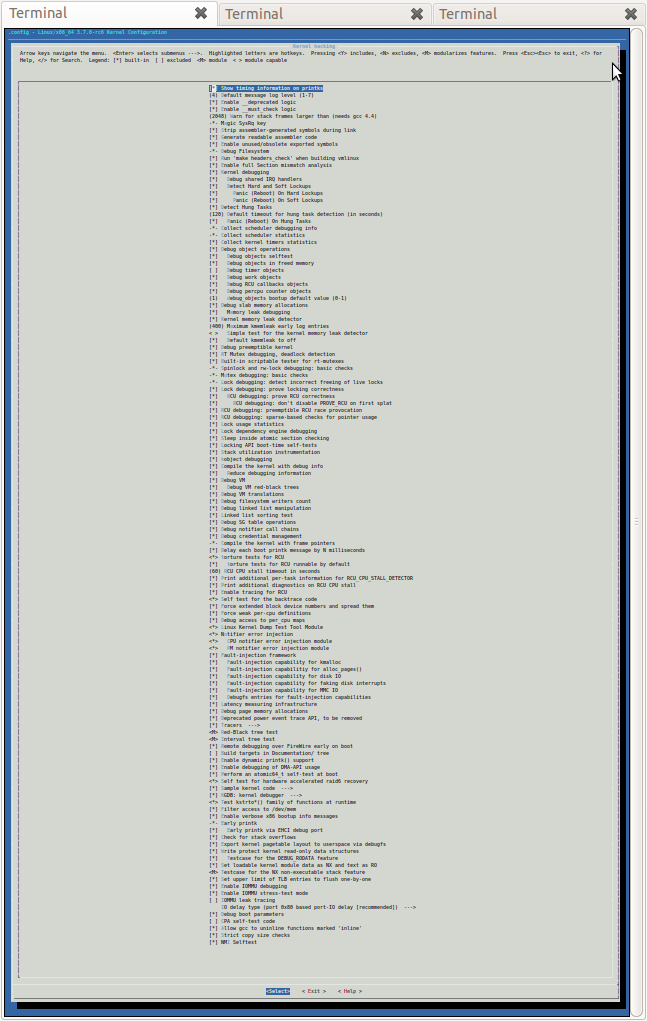
Merge Kconfig menu diet patches from Dave Hansen:
 "I think the "Kernel Hacking" menu has gotten a bit out of hand.  It is
  over 120 lines long on my system with everything enabled and options
  are scattered around it haphazardly.

        http://sr71.net/~dave/linux/kconfig-horror.png

  Let's try to introduce some sanity.  This set takes that 120 lines
  down to 55 and makes it vastly easier to find some things.  It's a
  start.

  This set stands on its own, but there is plenty of room for follow-up
  patches.  The arch-specific debug options still end up getting stuck
  in the top-level "kernel hacking" menu.  OPTIMIZE_INLINING, for
  instance, could obviously go in to the "compiler options" menu, but
  the fact that it is defined in arch/ in a separate Kconfig file keeps
  it on its own for the moment.

  The Signed-off-by's in here look funky.  I changed employers while
  working on this set, so I have signoffs from both email addresses"

* emailed patches from Dave Hansen <dave@sr71.net>:
  hang and lockup detection menu
  kconfig: consolidate printk options
  group locking debugging options
  consolidate compilation option configs
  consolidate runtime testing configs
  order memory debugging Kconfig options
  consolidate per-arch stack overflow debugging options